Executive Summary
- 18 data centers operate in the state of Queretaro, with 10-12 new projects being planned or installed.
- Crime is lower than neighboring states, but cartel activity remains of concern, with significant acts of violence probable.
- Environmental factors, particularly drought, not only threatens data center infrastructure, but increases the risk of protests targeting data centers and the reputation of companies over concerns regarding water usage.
In November 2024, the Secretary of Sustainable Development for the State of Queretaro in Mexico, Marco Antonio Del Prete Tercero, said that there were between 10 and 12 data center projects being planned or currently being installed in the state. These would increase the number of data centers in the state, currently at 18.
Companies such as Equinix, OData, Digital Realty, Zenlayer, and Oracle have a presence in the state already, with data centers concentrated in and around the Queretaro Metropolitan area, and providing colocation facilities for clients. Others like Amazon, Microsoft and Google are working on establishing cloud data center regions in the state, further increasing capacity for potential clients in Mexico and Latin America.
Data centers face a variety of threats in any country they operate, and while data centers in Mexico face similar ones, understanding the local context is key. The following report will look at the security context of the state of Queretaro, as well as the environmental issues that are likely to present complications for those operating or planning to operate data centers in the state.
Criminality
While criminality in the state of Queretaro has not yet reached the same levels as neighboring states such as Guanajuato or Mexico, the United States’ (U.S.) State Department recommends travelers to exercise increased caution in the state due to crime. Cartel activity remains rampant in the country, with the states of central Mexico including Queretaro, dominated by the Jalisco New Generation Cartel (CJNG). Violence in the central states of Mexico are driven by drug trafficking activities, as well as other criminal enterprises including cargo robbery and fuel trafficking. Fighting between the CJNG and other cartels like the Cartel Santa Rosa de Lima and Cartel Nueva Plaza in the neighboring state of Guanajuato has the potential to threaten activities in Queretaro. The National Defense Secretariat has reported on several cartels having a presence in Queretaro for years, including the CJNG, the Knights Templar, the Beltran Leyva Cartel, the Santa Rosa de Lima Cartel, and the Gulf Cartel.
The municipalities of Queretaro, El Marques, and Colon where data centers are primarily located in the state, are within 100km of the municipalities of Celaya and Apaseo el Grande in Guanajuato, which have seen 410 intentional homicides/femicides between January-October 2024 compared to 149 for the whole state of Queretaro in that same period. While the number of homicides remains low in those three municipalities compared to others in Mexico, national and international employees of data center companies should remain vigilant, as becoming collateral damage is possible. In November 2024, gunmen opened fire on a bar in downtown Queretaro, killing 10 people and injuring at least 13 others. The attack was believed to target a member of the CJNG, and speculation was that it was part of the fighting between cartels over the Queretaro-Guanajuato-Jalisco corridor, and will probably lead to an increase in violence.
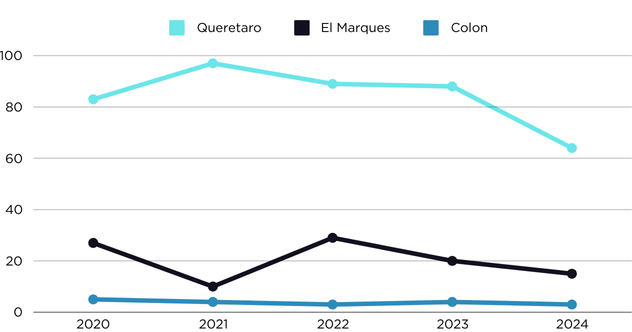
Threats most likely to impact residents within the municipalities of Queretaro, El Marques, and Colon are thefts and robberies. An increase in these types of crimes was reported between 2021 and 2023 from 16,516 to 17,380. Data for 2024 has not yet been fully recorded, but 13,922 incidences of thefts and robberies were reported between January and October. The U.S. Overseas Security Advisory Council (OSAC), in its Mexico country report, notes that it has “no evidence of criminals specifically targeting foreign or U.S. businesses and personnel” and that “criminals will target victims based on the appearance of affluence, vulnerability, or lack of awareness”. This does not mean that foreign and U.S. businesses have not become the victims of crime, such as extortion in order to operate. While data center employees or facilities may not yet be a primary target for criminals, the salaries associated with tech jobs and the brand recognition of some data center companies may pose a threat in the future.
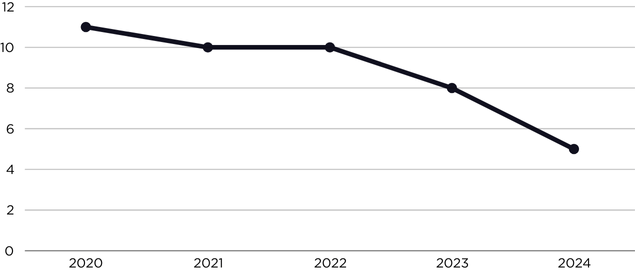
In regard to the telecommunications industry, no specific data is provided by the Executive Secretariat of the National Public Security System (SESNSP). The closest category reported are the theft of cables, tubes, and other materials used for public works, of which it reports no incidents in the state of Queretaro. However, in 2022, staff from Megacable said that activities of organized crime groups impacting the telecommunications sector had increased from Q4 of 2021 to Q1 of 2022, with incidents involving the abduction of technicians, and the vandalism and theft of infrastructure. The CEO of Megacable mentioned Queretaro as one of the states where incidents of vandalism had been recurrent over the 4 years prior to 2022.
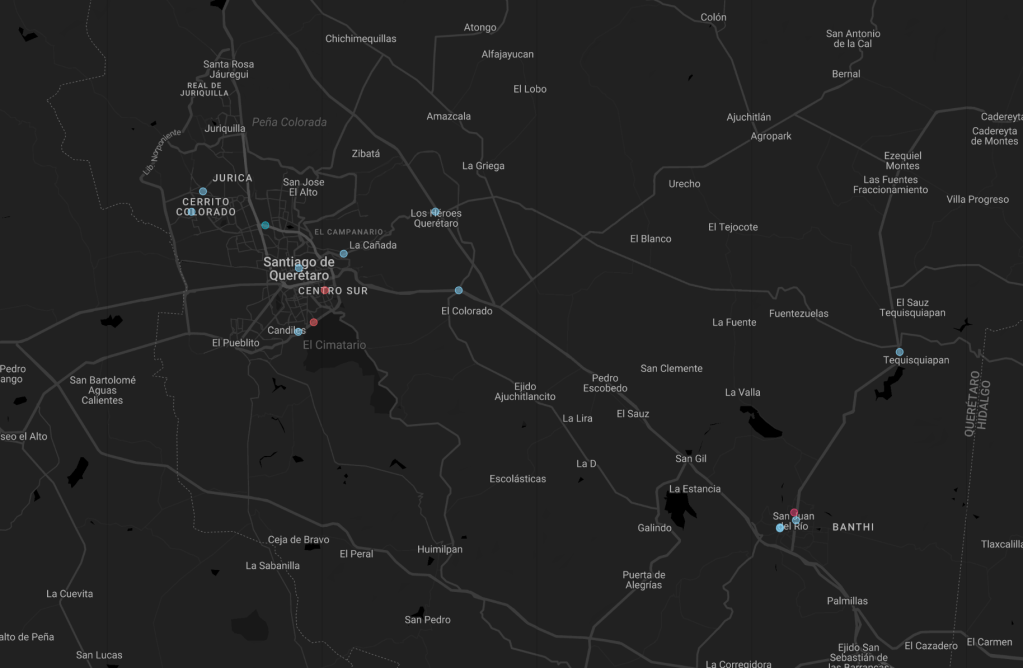
Open source reporting found several incidents of theft or attempted theft of telecommunications cables in the state of Queretaro, primarily in the municipality of Queretaro, El Marques, San Juan del Rio, and Tequisquiapan. In March 2024, internet service was impacted in the Mision Mariana neighborhood of Queretaro after fiber optic cables were stolen. The cables belonged to Telmex. In May of the same year, it was reported that the rate of thefts of copper telecommunications cables was increasing in the municipality of San Juan del Rio. Incidents from previous years were also recorded, with three suspects arrested in the municipality of El Marques in November 2021 for stealing fiber optic cables along Highway 200 near the Los Heroes subdivision, and a man arrested in the same municipality in June 2022 for attempted theft of cables. There has been no indication in open source reporting that data centers are currently being specifically targeted.
Drought, Water, and the Threat of Protests
The environmental impact of data centers and the resulting protests from activists has in the past delayed or led to a change in designs to address environmental concerns, as recently seen with Google’s planned data center in the Cerrillos area of Santiago, Chile. The already significant footprint of data centers in the state of Queretaro, and the planned addition of at least a dozen more facilities could in itself become a significant point of contention for environmental activists and local residents in the near future, particularly after the significant drought the state has faced. This was confirmed in July 2024 when environmentalists held a speech at the state congress to show opposition to the installation of data centers in the state due the high water consumption of the industry and the continued water crisis in the state.
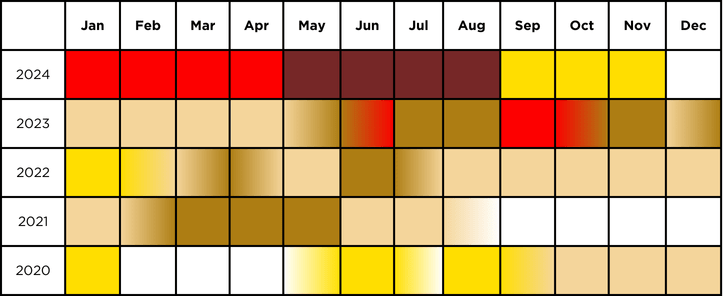
A long-term drought has impacted large parts of Mexico since the winter of 2022-2023, with data from the National Water Commission (CONAGUA) showing varying levels of droughts conditions in several municipalities of Queretaro prior to that period as well. The drought conditions have left reservoirs close to the municipalities of Queretaro, El Marques and Colon at low fill levels throughout the last five years, impacting industries and residents alike. With the rainy season in Queretaro running from June to September, fill levels of reservoirs reported by CONAGUA shows that despite the rains, some reservoirs like the La Venta reservoir near Pedro Escobedo still below 50% capacity during those months in 2024. The drought conditions in central Mexico, including Queretaro, were caused and compounded by a weak La Nina cycle in 2022-2023, precipitation deficits the following cycle from El Nino, and compounded by a below average number of tropical wave both years. Drought conditions and heat waves led to the state of Queretaro declaring a state of emergency in May 2024, with measures staying in place until the drought no longer poses a risk to the safety and psychological wellbeing of residents.

During the same period as the drought, several protests have been reported in the state of Queretaro, including in some of the aforementioned municipalities, by local residents demanding the state government take action to improve water service and against the controversial Law Regulating the Provision of Drinking Water, Sewerage, and Sanitation Services of the State, popularly known as the Water Law. The law was approved on 19 May 2022, but received heavy criticism from the population, worried about water concessions being given to private companies and the use of water meters in certain real estate projects like condominiums.
Protests against the law continued after its passing, and in April 2024, the state congress approved reforms to the law. Two key changes were made, the first is the privileging of domestic and urban public use over other uses, in case of shortage, and the second is the guaranteeing of 50L of safe and continuous supply of water daily to all residents of the state. The majority of protests motivated by the passing of the Water Law were concentrated in the municipality of Queretaro, the state capital where the state government offices and the state water commission’s office are located. Despite reforms to the law, environmental activists still called for the repeal of the Water Law in July 2024, as well as demanding that the state stop promoting itself as a place where data centers can flourish.
Risk to Data Centers
The continued growth of the data center industry in the state of Queretaro may face complications in the near future. While criminality in the state remains low compared to neighboring states such as Guanajuato, cartel activity is present nonetheless, particularly from the CJNG cartel. Competition between cartels for territory and criminal enterprises is likely to lead to significant acts of violence, with the possibility of uninvolved civilians caught in the crossfire. The most likely acts of criminality that data centers or their employees face are robberies and thefts, most likely during the construction phase of the data center, prior to hardened security measures being fully put into place. This includes the threat to the transportation of materials and items to and from the sites.
Protests against data centers are possible in the near future, dependent on environmental conditions and resource allocation. The Water Risk Atlas assesses the municipalities of Queretaro, El Marques, and Colon as being Medium-High or High risk in its Overall Water Risk classification, a classification that looks at the physical quantity of water, quality, and regulatory risk among other categories. Projections for 2030 and beyond sees the municipalities of Queretaro and parts of El Marques reach an Extremely High risk of water stress, which looks at available water and the demand for water. Mexico’s National Coordination of Civil Protection and its National Center for Disaster Prevention assessed the municipalities of Queretaro and Colon as having a High vulnerability to climate change, with the municipality of El Marques having a low vulnerability.
Further drought conditions impacting the state and the municipalities where data centers are most prominent will possibly increase antagonistic relations between activists and residents and business interests that are, or perceived to be, high consumers of water. This will not only have reputational impacts, but it is possible, manifests into physical security concerns. Data center companies investing in educating the local population of the impact of their facility, or participating in projects to mitigate the impact of hazards on water sources, could mitigate some of the risks. Monitoring of crime and environmental factors will continue to be key for data center companies operating in the state of Queretaro to ensure the safety of its people, assets, and reputation.
 Intelicom
Leave a comment